Bismillahirrahmanirrahim.
Assalamu’alaikum warahmatullahi wabarakatuh.
Alhamdulillahi rabbil ‘alamin,
wa bihi nasta‘in ‘ala umurid-dunya wad-din,
wassalatu wassalamu ‘ala asyrafil anbiya’i wal mursalin,
wa ‘ala alihi wa sahbihi ajma‘in.
Amma ba‘du.
Rabbi ishrah li sadri, wa yassir li amri,
wahlul ‘uqdatan min lisani yafqahu qawli.
Aamiin ya Rabbal ‘alamin.
Your Excellency the Ambassador of the Republic of Azerbaijan to the Republic of Indonesia, Amb. Ramil Rzayev,
Respected leaders the Lembaga Da’wah Komunitas PP Muhammadiyah, especially Chairman Ustadz Muhammad Arifin, M.Ag.
Distinguished guests, elders, colleagues, and dear friends.
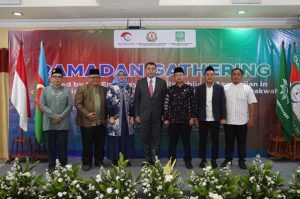
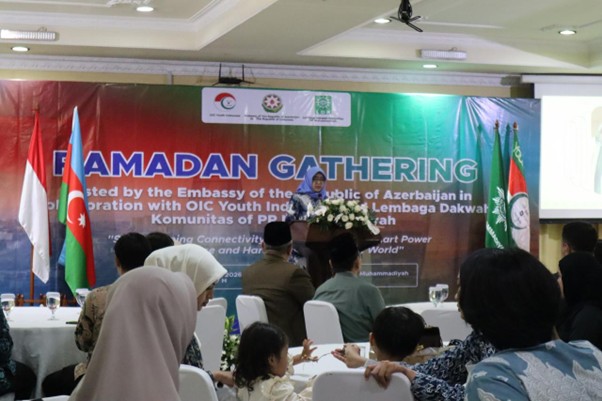
First of all, allow me to express our sincere gratitude for the presence of all of you at this iftar gathering.
Ramadan is often understood as the month of fasting.
Yet at its essence, Ramadan is the month of the Holy Qur’an, a month of clarity, realignment, and reflection. Fasting is not merely about restraint from food and drink; it is a discipline that helps us refocus on what truly matters in life,
Before I proceed further, allow me to pause for a moment to express our deepest condolences on the passing of an advisor of OIC Youth Indonesia, a respected figure who dedicated her life to service as Chairperson of the Indonesian Child Protection Agency (KPAI) and as Chairwoman of Fatayat Nahdlatul Ulama, Ibu Margaret Aliyatul Maimunah.
May her lifelong devotion, and service be accepted as lasting charity and good deeds, and may her soul be granted the highest place in Jannah. Aamiin.
Excellency, ladies and gentlemen,
The theme of this gathering, “Strengthening Connectivity and Values-Based Smart Power for Tolerance and Harmony in the Islamic World,” reflects a conviction we deeply hold: that harmony is not something we inherit automatically, and taken for granted but something we must consciously strengthen and maintain.
This principle is clearly affirmed in the Holy Qur’an. Allah SWT says in Surah Al-Hujurat, ayah 13:
يَا أَيُّهَا النَّاسُ إِنَّا خَلَقْنَاكُم مِّن ذَكَرٍ وَأُنثَىٰ وَجَعَلْنَاكُمْ شُعُوبًا وَقَبَائِلَ لِتَعَارَفُوا ۚ إِنَّ أَكْرَمَكُمْ عِندَ اللَّهِ أَتْقَاكُمْ ۚ إِنَّ اللَّهَ عَلِيمٌ خَبِيرٌ
“O mankind, indeed We created you from a male and a female and made you peoples and tribes so that you may know one another. Indeed, the most noble of you in the sight of Allah is the most righteous of you.”
As Prof. Dr. Abdul Mu’ti, General Secretary of the Central Board of Muhammadiyah and Minister of Primary and Secondary Education of Indonesia, writes in his book Toleransi yang Otentik (Authentic Tolerance),that tolerance grows when interactions increase, when people meet, communicate, and come to know one another.
Ramadan itself offers many examples of how tolerance is practiced in everyday life.
Not only as something that exists between Muslims who fast and those who do not fast, including our non-Muslim brothers and sisters
But tolerance also exists within the Muslim community itself. Islam recognizes that not every Muslim is obligated to fast under all circumstances. Those who are traveling long distances, those who are ill, or those who must take medication are given ease and flexibility in fulfilling their religious obligations. Bayangkan kalau semua restoran dan tempat makan tutup. Para musafir harus membawa bekal semuanya dari rumah.
And speaking of Indonesia and Azerbaijan,
There are also historical narratives that remind us how interconnected the Islamic world has always been. One such hypothesis, discussed by scholars including Azerbaijani researcher Zaur Aliyev, suggests that Maulana Malik Ibrahim, one of the Wali Songo known as Sunan Gresik, may have originated from the Caucasus region, including present-day Azerbaijan.
Looking ahead, Azerbaijan will not only host the Islamic Summit in 2026, welcoming heads of state from OIC member countries but has also played an important role within the OIC ecosystem, particularly in advancing youth engagement and youth diplomacy.
From hosting the first General Assembly of Islamic Cooperation Youth Forum to supporting regional OIC institutions, Azerbaijan has demonstrated something essential: trust in youth as part of national continuity.
This lesson is especially meaningful for us.
We are gathered this evening in the Central Board of Muhammadiyah, a living testament to the power of civil society. Founded in 1912, long before the Republic of Indonesia was proclaimed in 1945, Muhammadiyah reminds us that education, progress, and community service are foundational acts of faith.
In diplomacy, there are concepts known as Track Two and Track 1.5 engagement.
Track Two diplomacy refers to dialogue and cooperation led by civil society, scholars, and community organizations,
Track 1.5 engagement brings together government officials and non-government actors,
Organizations like Muhammadiyah and youth platforms such as OIC Youth Indonesia contribute to strengthening these bridges.
It is within this spirit that OIC Youth Indonesia was founded more than 21 years ago, in 2004.
The continuity of this institution would not be possible without the dedication and guidance of our Senior Advisors and Advisors, many of whom are present with us this evening.
Allow me to acknowledge with deep appreciation Amb. Prof Husnan Bey Fananie, Bunyan Saptomo, and representing senior advisor from the Ministry of Foreign Affairs, Bapak Agustian Aditya from Directorate of Public Diplomacy.
We are also honored by the presence of Beni Pramula, former chairman of Ikatan Mahasiswa Muhammadiyah and by the way, congratulations on the Anniversary of the founding of Ikatan Mahasiswa Muhammadiyah; Hamaydi Harahap; Suaeb; Rayan, and Pak Rifa Arifin.
I thank all the executive board members for their contribution and presence, and the Model OIC Clubs representatives for your time,
For us as the current leadership, the question we constantly reflect upon is simple, yet demanding:
If we were to step aside tomorrow , would this organization continue to stand?
If the answer is yes, THEN we are doing something RIGHT
Dear Brothers and Sisters,
Youth are often described as agents of change. But change without strong foundation can be fragile.
What the Islamic world needs today are young people who are rooted in values, conscious of history, respectful of elders, and committed to building institutions , not only movements.
As we prepare to break our fast together this evening, may this Ramadan renew not only our strength, but also our sense of responsibility to one another.
Thank you for coming, and our sincere appreciation to the Embassy of Azerbaijan and the Lembaga Dakwah Komunitas PP Muhammadiyah for this collaboration.
Wassalamu’alaikum warahmatullahi wabarakatuh.